

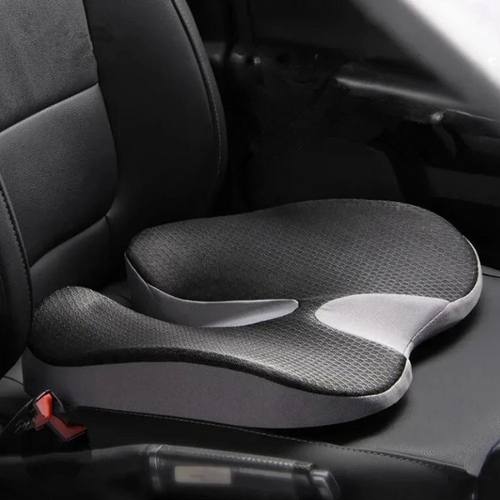


Reviews are the closest thing most buyers get to a long-term test of a car seat cushion. They are also uneven: many are written on day one, some are incentivised and a few are simply fake. This guide shows you how to read car cushion reviews, which details actually predict comfort after months of driving, and the red flags that should make you scroll past. Mobilaxa has not run independent tests, so you will find no star ratings or rankings here, only criteria you can check yourself.
Why reviews matter more for a car cushion than for most products
A cushion feels different on the first drive and on the fortieth. Whether the foam still recovers, whether it creeps forward under braking or gets hot in July only shows up with time. Many return policies also require the item to be unused, which limits how far you can try it at home. That is why a good owner review, written after weeks of daily use, is worth more than a polished product photo.
What a useful car cushion review tells you
Ignore the star rating for a moment and look for reviews that describe these six things.
Long-term durability
The most valuable review is the honest owner review posted, or updated, after several weeks or months. Look for comments on whether the cushion has flattened, whether it keeps a permanent dip where you sit, and whether the cover has bobbled or the seams have opened. A memory foam seat cushion should slowly recover its shape after you stand up. If several long-term reviews of the same product say it went flat within weeks, believe them, whatever the average score says.
Slipping and fit on a car seat
Car seats are not office chairs. Reviews from drivers with leather seats or sporty bucket seats with high side bolsters are especially useful: they reveal whether the non-slip base really grips, whether the cushion is pushed up at the edges, and whether it is too long for the seat and presses behind the knees. A comment such as "slides forward every time I brake" is a deal-breaker for a seat cushion.
Heat and breathability
Memory foam holds body heat, and a car parked in the sun gets hot. Reviews written in summer tell you whether the cover breathes. Mesh and spring cushions stay cooler but spread pressure less evenly. If you have heated or ventilated seats, look for reviewers who mention them: a thick cushion reduces the effect of both.
Height and driving position
Few reviewers mention it, but every seat cushion raises you by its own thickness and every lumbar cushion pushes you forward. A remark like "I now sit noticeably higher" is a prompt to check your head room, your view of the road and where the seat belt falls before you buy.
Installation
There is little DIY installation involved: a seat cushion simply sits on the seat. Lumbar and neck cushions use straps, and the useful reviews say whether those straps fit around wide backrests or headrest posts and stay put. Anything with a 12V plug, such as a heated or massage cushion, needs its cable routed well away from the pedals and the seat runners.
Cleaning
Check whether reviewers confirm that the cover comes off and goes in the washing machine. As a rule, only the cover is machine-washable, not the foam.
In summary, here is what common review comments tell you, and what to check yourself.
| Detail in the review | What it tells you | What to check yourself |
|---|---|---|
| "Still firm after six months" | Foam density and recovery | That the review is dated and genuinely long-term |
| "Slides on my leather seats" | Grip of the base | Non-slip underside or straps |
| "Too hot in summer" | Breathability of the cover | Cover fabric, mesh panels |
| "Sits me much higher" | Thickness | Head room, view, seat belt position |
| "Straps don't fit my seat" | Fixing system | Strap length against your backrest |
Red flags: fake reviews and claims you cannot verify
Since April 2025, UK consumer law (the Digital Markets, Competition and Consumers Act 2024) explicitly bans fake reviews and the concealment of incentivised ones, and the Competition and Markets Authority can enforce it. That does not make every review honest. Be wary of:
- A burst of five-star reviews posted within a few days, especially on a new listing.
- The same names or phrasing appearing across different products in the same shop.
- Vague praise with no detail: "life-changing", "like sitting on a cloud", with no word on the car, the seat or how long the reviewer has used it.
- Reviews about a different product. Some marketplace listings pool reviews across variants, or keep the reviews of an older product under a new one.
- A score with no reviews behind it, such as a rating badge you cannot click through to read.
- Undisclosed freebies. A review of a product received free should say so.
- Medical promises: "cures sciatica", "doctor approved", "recommended by physiotherapists", "clinically proven", with no named source you can check. A cushion can relieve pressure and improve sitting comfort; it does not treat a condition.
- Unsourced figures: "90% of users feel relief in a week" means nothing without knowing who was asked and how.
"Verified purchase" only tells you the reviewer bought the item. It says nothing about whether the review is balanced. Read the three-star reviews too: they are often the most specific.
Cheap vs premium foam: is it worth paying more?
Price alone does not guarantee quality, but it does buy specific things you can compare: foam density (in kg/m³, when the seller states it), a removable and washable cover, a genuinely non-slip base, a clear return policy. A premium cushion is worth the extra only if reviews show it keeps its shape and stays in place for longer. A cheap cushion that flattens within a month costs more in the end if you replace it twice.
If you are really looking for the best ergonomic car seat because yours lacks lumbar adjustment, a cushion can correct one point, but it will not turn a poor seat into a good one. Our guide to choosing a car for long journeys covers what to look for in the seat itself.
How to choose once you have read the reviews
- Start from your need. Pressure under the buttocks or at the tailbone calls for a seat cushion with a rear cut-out; a lower back that slumps calls for a lumbar cushion; a stiff neck calls for a pillow on the head restraint. Our guides on car seat cushions for sciatica and lumbar support for a slipped disc go into each case.
- Filter reviews by use. A daily commuter and a holiday driver judge a cushion differently; look for reviewers who drive as you do.
- Check the dimensions against your seat: width between the side bolsters and depth of the seat base.
- Read the negative reviews for patterns rather than one-off complaints about delivery.
- Check the return policy and what condition the cushion must be in to send it back.
Safety checks no review will do for you
- The lap belt must still sit low across your hips and the diagonal across the middle of your shoulder.
- Never use a seat cushion under a child or on a seat fitted with a child car seat.
- Keep the cushion clear of the pedals and of any side airbag in the seat.
- After fitting it, re-set the seat, head restraint and mirrors with the car parked, never while driving.
- For heated cushions, follow the manufacturer's instructions, do not leave them unattended and unplug them when you stop.
And no cushion replaces a break: the Highway Code recommends at least 15 minutes after every two hours of driving. More ideas for long trips are in our guide to car accessories for long journeys.
ErgoSeat and ErgoComfort: the facts, not a star rating
Mobilaxa sells two of the cushion types discussed above, so we have an interest. Rather than rate them, here is what they are, so you can compare them with alternatives using the same criteria.
The ErgoSeat (£39.95) is a seat cushion in high-density memory foam, with an ergonomic shape and a rear cut-out that leaves room around the tailbone. It has a non-slip base and a removable, machine-washable black cover; the foam itself is not machine-washable. It works in the car, at the office or at home.
The ErgoComfort set (£49.95) combines a lumbar cushion that follows the curve of the back and a memory-foam neck pillow. Adjustable straps hold them on the backrest and head restraint, and the covers are removable and washable. It comes in Midnight Black or Silver Grey.
Neither is a medical device. They are comfort accessories, with no promise of treatment.
Related guides: Premium Leather Car Cushions: Real Leather, PU or Fabric, and Is Premium Worth It? and Orthopaedic Cushion Reviews: What the Label Means and Which Sources to Trust.
Frequently asked questions
Are car seat cushion reviews reliable?
Some are, many are not. Detailed, dated reviews from people who drive as you do, read across several platforms, are the most reliable. A high average score on its own tells you very little.
What do long-term owner reviews reveal about seat cushion durability?
The useful ones say whether the foam still recovers after months of use, whether the cover has worn and whether the cushion still grips the seat. Those details matter more than the number of stars.
Does a car seat cushion need installing?
No tools are needed. A seat cushion sits on the seat; lumbar and neck cushions attach with straps. What matters is re-setting your driving position afterwards.
Is a memory foam seat cushion better than a mesh one?
Memory foam spreads pressure better and suits tailbone or buttock discomfort; mesh stays cooler in hot weather. If heat is your main complaint, a breathable cover on a foam cushion is a middle ground.


