



A long drive goes better with a handful of well-chosen accessories than with a boot full of gadgets. This guide sorts the useful from the gimmicky across comfort, charging, breakdown kit, storage and family travel, and flags the UK rules that apply to phone mounts, dash cams and sunshades. It is a buyer's guide built on what each item does, not a product test.
The short list: what to buy first
If you only buy a few things, start at the top of this table and work down.
| Accessory | Problem it solves | Priority | Watch out for |
|---|---|---|---|
| Phone mount and USB-C car charger | Hands-free navigation; flat batteries | High | Must not block your view of the road |
| Breakdown kit | Being stuck at the roadside | High | Check it before winter |
| Lumbar or seat cushion | Back ache after an hour or two | High if you get back pain | Re-set the head restraint and belt after fitting |
| Tyre inflator | Low tyre pressure | Medium | Use the pressures in your handbook |
| Jump starter | Flat battery at a services car park | Medium | Charge it before the trip |
| Windscreen sunshade | A hot cabin after a stop | Medium in summer | Parked use only |
| Seat-back and boot organisers | Clutter and lost items | Medium for families | Secure anything heavy |
| Seat-belt pad | Belt rubbing the neck or shoulder | Low to medium | Must not change how the belt runs |
| Dash cam | Evidence after an incident | Optional | Mount it out of your line of sight |
Comfort: cushions, lumbar support and seat-belt pads
Lumbar and seat cushions
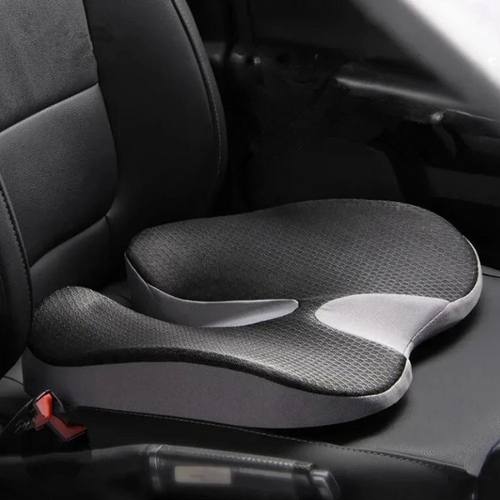
Back ache is the most common complaint on long drives, and it usually starts with a seat that lets your lower back round or leaves your knees higher than your hips. A lumbar cushion fills the hollow of the lower back at about belt height; a seat cushion spreads pressure under the buttocks and thighs. Fit either with the car parked, then re-set the head restraint and mirrors, because a seat cushion raises you. Never use one under a child or on a seat fitted with a child car seat. Our guide to car cushions for holiday trips compares the main types.
If the pressure is under the tailbone rather than in the lower back, a memory-foam seat cushion with a U-shaped cut-out at the back, such as ErgoSeat, keeps the coccyx clear while you sit. Check that it does not raise you so much that your head gets close to the roof lining or the seat belt sits differently.
Mobilaxa's ErgoComfort set (£49.95) pairs a lumbar cushion that follows the curve of the back with a memory-foam neck pillow, with adjustable straps for a stable fit, with removable covers that wash at a low temperature. It also works on an office chair or on a train.
Seat-belt pad
If the belt rubs your neck or digs into your shoulder after a few hours, first check whether your car has an adjustable upper belt anchor. A pad can then add comfort. The ErgoBelt (£19.95) is an embossed PU leather pad that sits on the shoulder strap only. Whatever pad you use, the belt must still tighten and retract freely; avoid any clip that holds the belt slack.
Neck pillows and heated covers
Neck pillows are mainly for passengers who want to sleep. They are comfort items, not safety equipment, and they must never replace a properly adjusted head restraint; our article on whether car neck pillows are safe explains why. For passenger options, see travel pillows for car journeys. A 12V heated seat cover is welcome in winter: follow the maker's instructions, do not leave it running unattended and unplug it when you stop.
Charging, navigation and in-car tech
- USB-C car charger. Choose one with enough output for the devices you carry and at least two ports, so the driver's phone and a passenger's tablet can charge together.
- Phone mount. In the UK it is illegal to hold and use a phone while driving, with a penalty of 6 points and a £200 fine. A mount lets you follow navigation hands-free, but it must not block your view of the road. Set the route before you set off.
- Wireless CarPlay or Android Auto adapter. For a car that only supports a wired connection, an adapter can save you plugging in every time. Check compatibility with your car and phone before buying.
- Offline downloads. Download maps, playlists, podcasts and films before you leave; signal drops in rural areas.
- Dash cam. Useful if you need evidence after an incident. Mount it behind the rear-view mirror or low on the windscreen, out of your line of sight, and route the cable neatly.
Breakdown and emergency kit
- Warning triangle, hi-vis vest and torch. The Highway Code says not to use a warning triangle on a motorway. If you break down there, leave the car by the left-hand door if you can, get behind the safety barrier and call for help.
- First-aid kit, water, snacks and a blanket, especially in winter.
- Tyre inflator. A 12V model is enough for topping up. Check pressures with the tyres cold, using the figures in your handbook or on the door frame.
- Jump starter. Charge it at home before the trip and keep it somewhere you can reach without unloading the boot.
- Power bank, so you can still call for help if the car battery is flat.
- Winter extras: ice scraper, de-icer and screenwash.
Storage and organisation
A seat-back organiser gives rear passengers somewhere for a tablet, a bottle and snacks, and a boot organiser stops shopping and bags sliding about. Two rules apply. First, secure anything heavy, because loose objects can be thrown forward under hard braking. Second, keep the driver's footwell clear: a bottle that rolls under the pedals is a real hazard.
Sun and heat: windscreen sunshades
A sunshade keeps the cabin and the steering wheel cooler during stops, which makes a difference on summer journeys with children. It is for parked use only and must always come down before you drive. The SunShield (£39.95) opens like an umbrella, has a V-shaped notch that fits around the rear-view mirror and folds into a pouch for the door pocket. It comes in two sizes, Standard (140 × 79 cm) and Large (145 × 83 cm), so measure the inside of your windscreen first.
For children in the back, clip-on side blinds on the rear windows are common. Keep anything of that kind off the windscreen and front side windows.
Keeping passengers and children happy
- A tablet holder on the back of a front seat, with headphones, keeps films and games out of the driver's earshot.
- Spill-proof bottles and a small bag for rubbish make stops quicker.
- A blanket and a travel pillow help children sleep; use only accessories approved by the maker of their car seat on the seat itself.
- Plan the stops as part of the trip, not as interruptions.
Popular and must-have car accessories in 2026
Trending gadgets come and go, but the car accessories that keep earning their place on long journeys are the practical basics: a secure phone mount and a fast charger, a seat or lumbar cushion for long stints, a boot organiser, a windscreen sunshade and a properly stocked breakdown kit. If you are choosing your must-have car accessories for 2026, start there before anything novel.
Car protection accessories. A boot liner or mat is worth it if you carry muddy kit or a dog, washable seat covers help in family cars, and a sunshade keeps the dashboard and seats cooler when the car is parked in the sun.
Backseat entertainment. For children, a tablet holder fixed to the back of the front head restraint and a pair of headphones go a long way. Keep devices secured: anything loose can be thrown forward under hard braking.
What to skip
- Gadgets fixed to the middle of the windscreen or hanging from the mirror, where they block your view.
- Seat covers that are not designed for seats with side airbags.
- Anything you would need to adjust while driving.
- Neck pillows or cushions sold as whiplash or crash protection: no accessory does that job.
- Cheap, unbranded 12V plugs and cables that run hot.
Before you set off: a quick checklist
- Tyres: pressures checked and tread above the legal minimum of 1.6 mm.
- Oil, screenwash and lights checked.
- Seat, cushions, head restraints and mirrors adjusted while parked.
- Route loaded and phone in its mount; chargers plugged in.
- Breakdown kit, water and snacks packed; heavy items secured.
- Breaks planned: the Highway Code recommends at least 15 minutes after every two hours of driving. If you feel sleepy, stop somewhere safe (not the hard shoulder). Our guide to driver health on the road covers fatigue in more detail.
Related guides: Premium Leather Car Cushions: Real Leather, PU or Fabric, and Is Premium Worth It? and Best Cars for Long Journeys: How to Choose One That Stays Comfortable.
Frequently asked questions
What are the essential car accessories for a long road trip?
A phone mount and charger for hands-free navigation, a breakdown kit with a hi-vis vest and first-aid kit, a tyre inflator, and comfort support if you get back pain. Everything else depends on who is travelling and the season.
What should I keep in my car for a long journey?
Water, snacks, a blanket, a torch, a first-aid kit, a power bank and a charged phone. In winter add an ice scraper, de-icer and warm clothing in case you are delayed.
Which tech is most useful for long-distance driving?
A good USB-C charger, a secure phone mount, a wireless CarPlay or Android Auto adapter for older cars, and content downloaded before you leave. A dash cam is useful but optional.
Can I mount my phone on the windscreen in the UK?
Yes, as long as it does not block your view of the road and you only use it hands-free. Low down or to one side is better than in the middle of the glass.
Which car gadgets are not worth buying?
Anything that blocks your view, needs attention while you drive, or promises safety benefits it cannot deliver, such as neck pillows sold as whiplash protection.


